True / False / Not Given (and Yes / No / Not Given) explained
The difference between False and Not Given is where most Reading marks are lost. Learn the one question to ask for each statement, and why your own knowledge must stay out of your answer.
IELTS Band Trainer team · 15 October 2026 · 2 min read
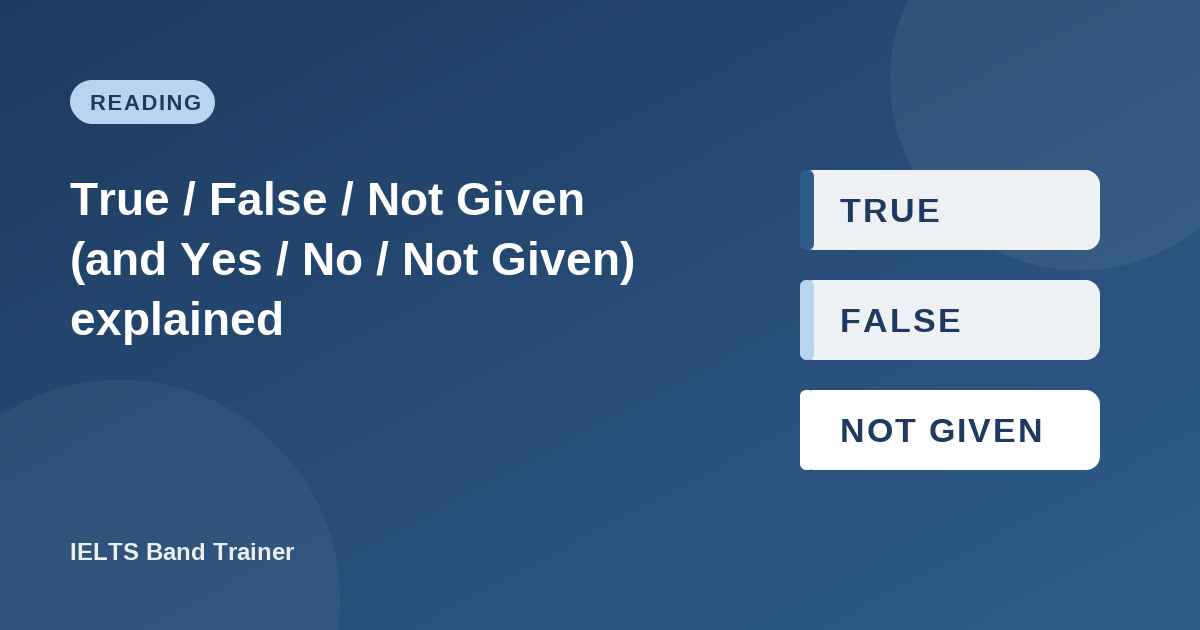
True / False / Not Given questions appear in almost every Reading test. They feel difficult because two of the answers, False and Not Given, can seem very similar. They are not similar once you know what each one means.
What each answer means
- True: the passage says the same thing as the statement, usually in different words.
- False: the passage says the opposite of the statement, or something that cannot also be true.
- Not Given: the passage does not say whether the statement is true or not. The information is missing, or only part of it is there.
Yes / No / Not Given works the same way, but it is about the writer's opinions or claims rather than facts.
The question to ask
For each statement, find the part of the passage it refers to and ask: does the passage contradict this statement? If yes, the answer is False. If the passage agrees, it is True. If you cannot find anything that agrees or contradicts, it is Not Given.
A worked example
Passage: The first public library in the town opened in 1890, funded by local factory owners.
- The library opened in the nineteenth century. True: 1890 is in the nineteenth century.
- The library was paid for by the government. False: it was funded by factory owners.
- The library was popular with factory workers. Not Given: the passage says who paid for it, not who used it.
Traps to watch for
- Your own knowledge: answer only from the passage. A statement can be true in real life and still be Not Given in the test.
- Qualifying words: all, some, always, usually, only. A statement that says all when the passage says most is False.
- Keyword matching: finding the same words in the passage does not make a statement True. Check the meaning of the whole sentence.
- Order: the answers usually appear in the same order as the passage, which helps you find the right place quickly.
Write the answer correctly
Write TRUE, FALSE or NOT GIVEN in full, or T, F and NG if the instructions allow it. Writing Yes on a True / False question can be marked wrong, so copy the exact form the instructions use.
Our Reading practice shows your accuracy for each question type, so you can see whether this one is holding your band back.
- reading
- true false not given
- question types
Put it into practice
Take a free timed practice test and get a band estimate straight away.