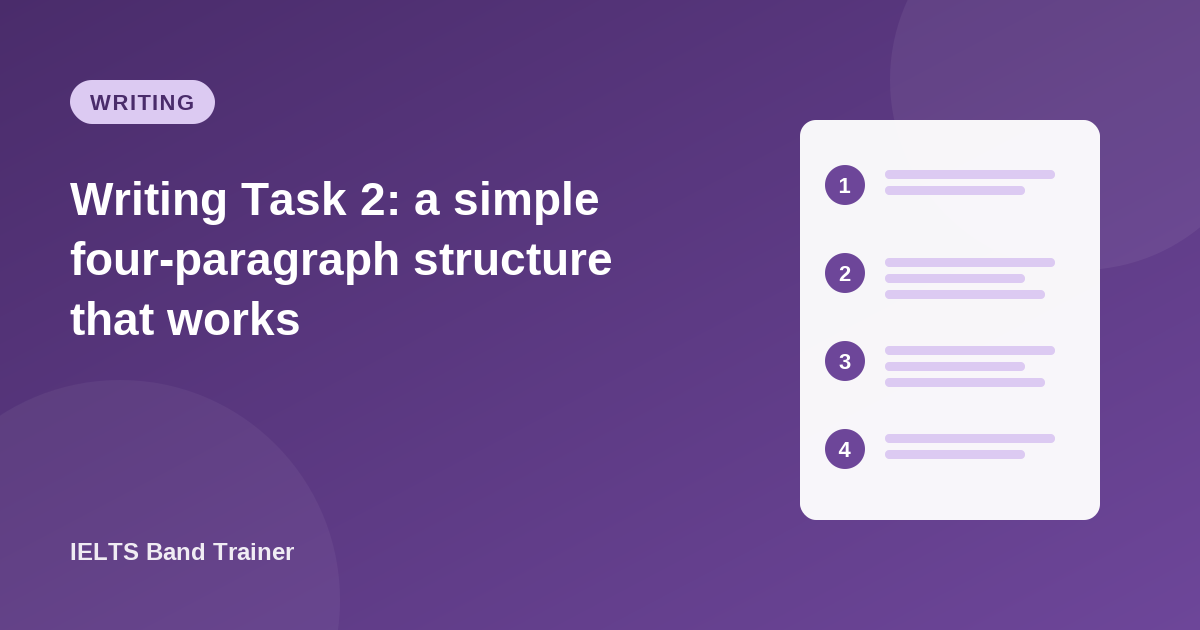
Writing Task 2: a simple four-paragraph structure that works
A clear plan matters more than clever words in Task 2. This four-paragraph structure answers every part of the question, keeps your argument easy to follow and fits comfortably into 40 minutes.
IELTS Band Trainer team · 30 October 2026 · 3 min read
Task 2 is worth twice as much as Task 1, and the most common reason for a disappointing band is not grammar or vocabulary but organisation. Examiners need to see a clear position, ideas that are developed rather than listed, and paragraphs that each do one job. This structure gives you all three.
Before you write: five minutes of planning
Read the question twice and underline what it actually asks. Is it an opinion question (to what extent do you agree), a discussion (discuss both views and give your opinion), an advantages and disadvantages question, or a problem and solution question? Many essays lose marks under Task Response because they answer a slightly different question from the one on the paper. Then note two main ideas, each with one reason and one example.
Paragraph 1: introduction (two or three sentences)
Paraphrase the topic in your own words, then state your position clearly. Do not copy the question, and do not start with a general statement that could introduce any essay. An introduction of about 40 to 50 words is enough.
Example: Some people believe that governments should pay for university education, while others think students should cover the cost themselves. In my view, public funding is the better choice, although students should contribute something towards it.
Paragraphs 2 and 3: one main idea each
Start each body paragraph with a topic sentence that states its main idea. Then explain why it is true, and support it with an example or a likely result. Aim for four or five sentences in each paragraph. Developing one idea fully scores higher than mentioning three ideas briefly.
- Topic sentence: the main point of the paragraph.
- Explanation: why it is true or why it matters.
- Example: a realistic situation, not invented statistics.
- Link back: how this supports your position.
For a discussion essay, use paragraph 2 for the first view and paragraph 3 for the second, and make your own opinion clear in the introduction and the conclusion.
Paragraph 4: conclusion (two sentences)
Summarise your position and the main reasons. Do not add a new idea here. A conclusion that clearly matches your introduction helps the examiner see a consistent position throughout.
Linking words: use them, but not on every line
Words such as however, therefore and for example help the reader follow your argument. Overusing them, especially at the start of every sentence, can lower your Coherence and Cohesion score. Referencing words such as this, these and such measures often link ideas more naturally.
Timing
Spend about five minutes planning, 30 minutes writing and five minutes checking. Use the checking time for errors you know you make, such as articles, plurals and subject-verb agreement. Aim for 260 to 300 words: enough to develop your ideas, without leaving too little time to check.
Practise with a timer, then compare your essay with the four criteria. Our Writing tests give you an instant estimate, and Premium adds a teacher's mark with comments on each criterion.
- writing task 2
- essay structure
- coherence
Put it into practice
Take a free timed practice test and get a band estimate straight away.