How IELTS band scores are calculated (and how your overall band is rounded)
Your overall band is the average of four skill bands, rounded in a specific way. Here is exactly how Listening and Reading scores convert, how Writing and Speaking are marked, and why a 6.75 average becomes a 7.
IELTS Band Trainer team · 3 November 2026 · 3 min read
Every IELTS result is reported on a scale from 0 to 9, in half bands. You get a separate band for Listening, Reading, Writing and Speaking, and an overall band that is the average of the four. Knowing how each one is produced helps you decide where extra practice will lift your result the most.
Listening and Reading: from raw score to band
Listening and Reading each have 40 questions worth one mark each. Your raw score out of 40 is converted to a band using a conversion table. The table changes very slightly from test to test to keep results fair across different papers, so the figures below are typical rather than exact.
- Listening: about 30 correct answers gives band 7, 23 gives band 6, and 16 gives band 5.
- Academic Reading: about 30 correct answers gives band 7, 23 gives band 6, and 15 gives band 5.
- General Training Reading: the texts are less demanding, so you need more correct answers for the same band: about 34 for band 7 and 30 for band 6.
Spelling and grammar count in Listening and Reading answers. A correct word spelled wrongly, or an answer that goes over the word limit, scores zero.
Writing: four criteria, two tasks
Examiners mark each Writing task against four criteria of equal weight: Task Achievement (Task 1) or Task Response (Task 2), Coherence and Cohesion, Lexical Resource, and Grammatical Range and Accuracy. Task 2 counts twice as much as Task 1, so a strong essay can make up for a weaker Task 1, but not the other way round.
Writing too little costs marks. Task 1 needs at least 150 words and Task 2 at least 250 words. Copying the question does not count towards your total.
Speaking: four criteria
The Speaking test is marked on Fluency and Coherence, Lexical Resource, Grammatical Range and Accuracy, and Pronunciation, again with equal weight. The examiner listens to the whole interview, not just one part, so a nervous start does not decide your band.
How the overall band is rounded
The overall band is the average of your four skill bands, rounded to the nearest half band. When the average falls exactly between two half bands, it is rounded up:
- An average ending in .25 rounds up to the next half band: 6.25 becomes 6.5.
- An average ending in .75 rounds up to the next whole band: 6.75 becomes 7.0.
- Other averages go to the nearest half band: 6.125 becomes 6.0 and 6.375 becomes 6.5.
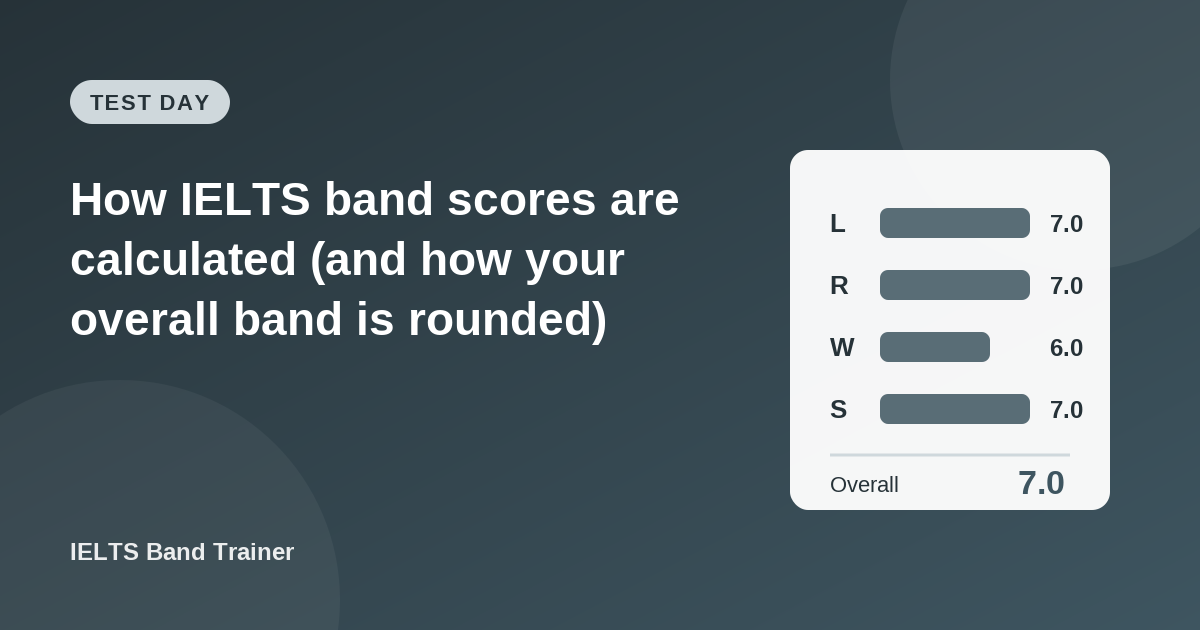
For example, Listening 7.0, Reading 7.0, Writing 6.0 and Speaking 7.0 add up to 27, an average of 6.75, so the overall band is 7.0.
What this means for your preparation
Many universities and visa routes ask for a minimum in each skill as well as an overall band, so check both numbers in your target. Because the overall band is an average, raising your weakest skill by half a band is often the quickest way to reach your target. Our practice tests convert your raw scores with the same kind of tables and show where each half band is won or lost. Remember that practice scores are estimates: only an official test gives you an official result.
- band scores
- marking
- overall band
Put it into practice
Take a free timed practice test and get a band estimate straight away.