Lexical Resource: using less common vocabulary without sounding unnatural
Higher bands reward precise, less common words, but only when they are used correctly. Learn words in phrases, focus on collocation and topic language, and avoid the memorised phrases examiners hear every day.
IELTS Band Trainer team · 5 October 2026 · 2 min read
Lexical Resource is one quarter of your Writing and Speaking bands. The band descriptors reward a wide range of vocabulary, less common items, awareness of style and collocation, and control: using words accurately and appropriately. The last part is where many candidates lose marks.
Precision beats difficulty
A less common word only helps if it is the right word. Saying that a problem is ubiquitous when you mean serious makes your writing less clear, not more advanced. Choose the word that says exactly what you mean: a significant increase, a gradual decline, a widespread belief.
Learn words in phrases
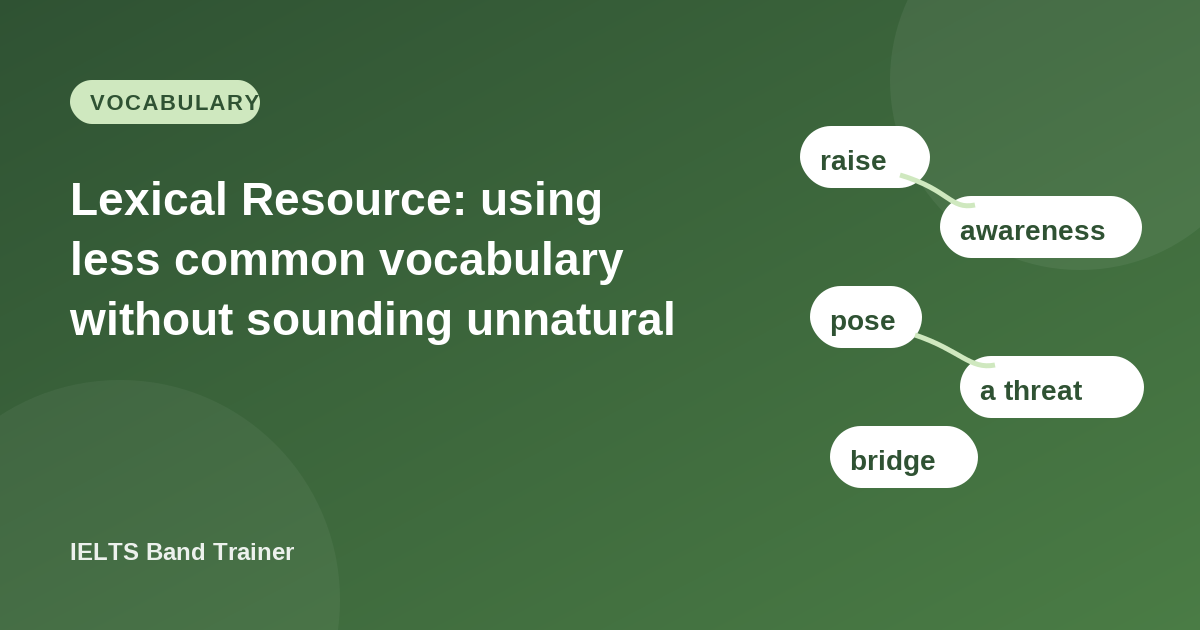
Words are used in combinations called collocations. We make a decision, not do a decision; we pose a threat, not give a threat. Learning words in their usual partners makes them easier to use correctly.
- raise awareness of
- have a detrimental effect on
- bridge the gap between
- a growing body of evidence
- meet the demand for
Build vocabulary by topic
IELTS questions come from familiar topics: education, environment, technology, health, work, cities and transport. For each topic, collect 15 to 20 useful phrases with an example sentence. Our vocabulary sets group words by level with synonyms and examples, which makes this easier to practise.
Paraphrase the question
Rewriting the question in your own words in the introduction is an easy place to show range. Change the structure as well as the words: young people who use social media frequently can become frequent use of social media among teenagers.
Avoid memorised phrases
Examiners are trained to recognise memorised language. Phrases such as in this day and age or it is a double-edged sword are not wrong, but repeated without purpose they add nothing and do not show what you can really do with English. Use language that fits your argument.
Match the style
Academic writing needs a neutral, formal style: children rather than kids, a large number of rather than lots of. In Speaking, natural informal language is appropriate, including idiomatic expressions used correctly.
A simple routine
- Learn five new phrases a day from one topic.
- Write one sentence of your own with each phrase.
- Use two of them in your next practice essay or speaking answer.
- Review older phrases once a week.
Steady, active practice like this builds a vocabulary you can actually use under exam pressure.
- vocabulary
- lexical resource
- collocations
Put it into practice
Take a free timed practice test and get a band estimate straight away.